
Claude Pro vs Max 5x vs Max 20x: Price, Usage and Claude Code Compared
An Anthropic-sourced comparison of Claude Pro, Max 5x and Max 20x for Hong Kong readers: official US pricing, per-session and weekly usage, Claude Code, usage credits, Fable, our HKD service prices, and a seven-day log you can run yourself before deciding to upgrade.

On this page
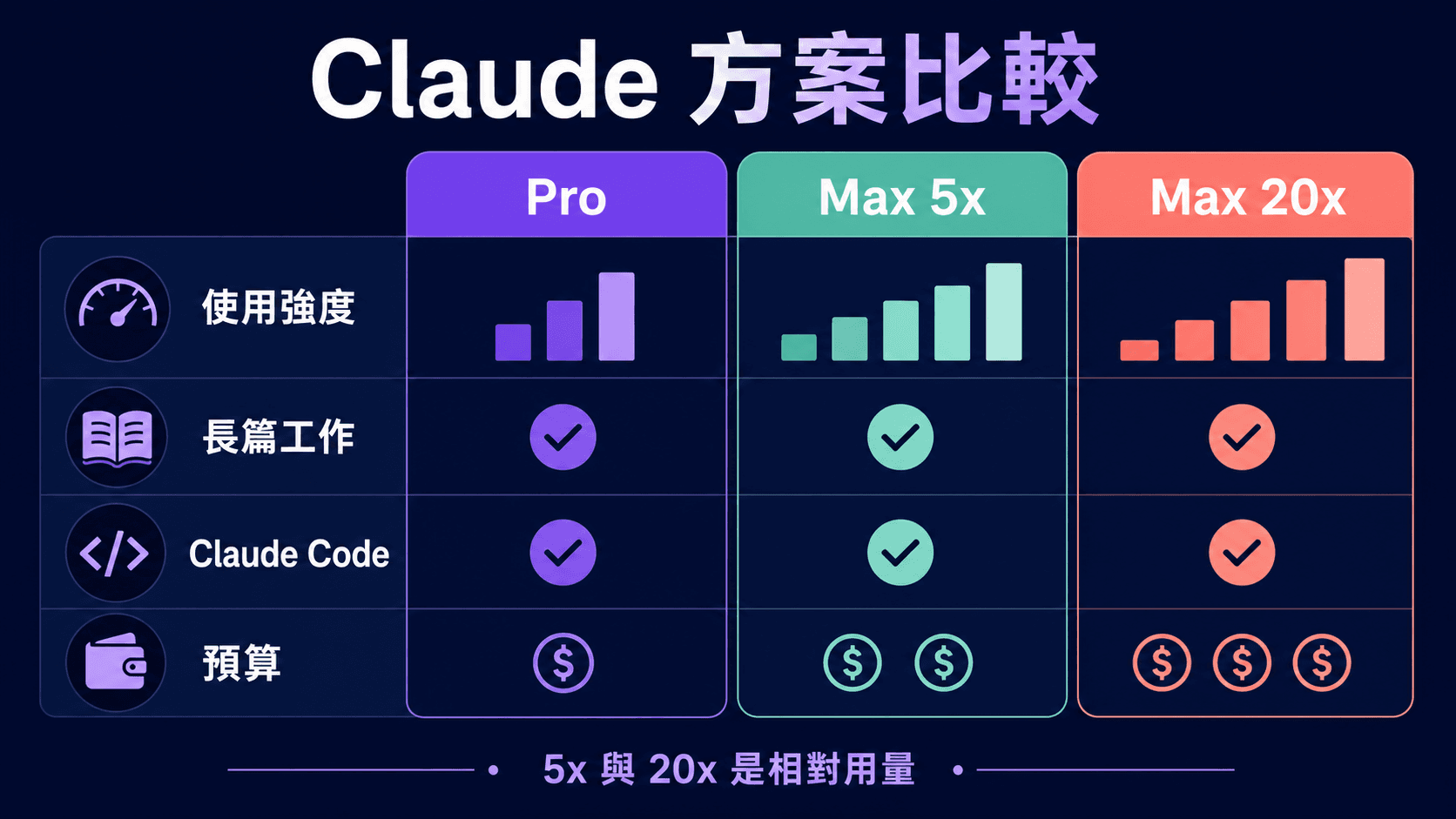
The difference between Claude Pro, Max 5x and Max 20x is not simply cheap, mid and expensive. The question worth answering is how much long context, how many attachments and how many Claude Code runs your week actually needs, and what an hour of being rate limited costs you.
Facts checked: 15 September 2026. Prices, features, regional availability and usage policies all change. This guide uses the official Anthropic pricing page, the plan support articles and the usage documentation as its baseline. Every price quoted is US pricing and, as the pricing page states, prices shown do not include applicable tax. Re-check the official pages before you pay.
Supported regions (checked 15 September 2026): Hong Kong does not appear on Anthropic's supported countries and regions list, which covers commercial API access and Claude.ai. Read our pre-subscription guide for Claude in Hong Kong (Traditional Chinese) first. This article compares plans only. It does not suggest a VPN, a foreign address, a borrowed phone number, someone else's identity or someone else's account, and none of those are safe or supported ways around a regional restriction.
The three personal Claude plans at a glance
| Plan | Official US price (excl. tax) | Relative usage position | Better suited to |
|---|---|---|---|
| Claude Pro | US$20/month | The paid individual baseline; at least five times the usage per session of the free service | General writing, documents, research and occasional Claude Code |
| Claude Pro, annual | US$200 billed up front (an average of US$17/month) | Same as monthly Pro | People confident they will use it for roughly ten months or more; Max has no annual option |
| Claude Max 5x | US$100/month | Five times more usage per session than Pro, plus a weekly limit | Daily heavy use, longer documents, frequent Claude Code |
| Claude Max 20x | US$200/month | Twenty times more usage per session than Pro, plus a weekly limit | All-day intensive work across many large sessions where Max 5x still blocks you |
Fable 5 and 5.1 (checked 15 September 2026): available on all paid plans. Max includes them, and you may use up to 50% of your weekly usage limits on Fable models at no extra cost; on Pro they are not included in the plan's usage limits and run on usage credits instead. The earlier promotion, which covered Fable 5 only, ended on 19 July 2026 at 11:59:59 PM PT. The full rules live in our Fable plan rules explainer (Traditional Chinese).
These are official US prices. They do not mean the plan can be bought everywhere, and they exclude tax and any foreign-transaction fee your card charges. Our HKD cost calculator lets you separate the exchange rate, card fees and the number of months you will actually use.
What "5x" and "20x" actually mean
Anthropic's Max plan article states that Max 5x provides five times more usage per session than Pro and Max 20x provides twenty times, and that Max plans also have a weekly usage limit that applies across all models. You are not buying a fixed bundle of 500 or 2,000 messages, and it is not a token wallet. How far the allowance actually goes shifts with:
- the length of your inputs and outputs, and the context a conversation accumulates;
- the number, size and content of files you upload;
- the model, features and tools you use;
- in Claude Code, repository size, how many files get read, and how long an instruction or agent run lasts;
- the session, weekly, model and fair-use limits in force on the platform at that moment.
That is why "how many questions can I ask per month" has no answer that is accurate for everyone. Ten short rewrites can cost far less than one exploration and refactor of a large codebase. For how limits reset and what drains them, see Claude usage limits on Pro, Max and Claude Code.
Two layers of limits: per session and per week
Anthropic's plan articles split usage into two layers, and you need both to read your own situation correctly.
- Session usage resets every five hours. The Pro plan article states that Pro gives at least five times the usage per session compared with the free service; Max 5x and Max 20x are then five and twenty times Pro per session.
- Weekly usage resets at a fixed time each week that is assigned to your account. Both the Pro and the Max articles state that the weekly limit applies across all models, and the Pro article is explicit that your reset day and time stay the same regardless of when you start using Claude or when your subscription begins.
Both layers apply at once, so "my session just reset" does not guarantee you can carry on. If the week's allowance is gone, you wait for the weekly reset. Settings → Usage shows your progress against both.
How to turn those two numbers into a decision:
- You hit the session limit often, but the week is never tight. Check whether single work blocks are too concentrated: too many files uploaded at once, or context that has grown very long. Spreading the same work across the day may be enough on its own.
- Your weekly limit is gone by midweek. That is the honest signal that your total workload sits above the plan, and the point at which comparing the next tier or usage credits is reasonable.
- You hit both often. Confirm with a seven-day log that it is genuine volume rather than wasted context, then price the upgrade.
What each plan looks like in real work
Claude Pro: prove the workflow is worth something
Pro suits people who have a few deep tasks a week rather than a tool running from morning to night:
- rewriting a proposal, a policy or a long article;
- summarising a batch of public documents, then verifying the result by hand;
- a few Claude Code sessions a week to explain code, plan a change or ship a small feature;
- turning meeting notes, research and working notes into something actionable.
If you have never measured your own usage, running Pro as a research baseline usually tells you more than jumping straight to Max 20x. Anthropic's Pro article lists Claude Code access and Cowork access as included, so you can try coding work without buying Max on day one.
Max 5x: interruptions are already costing you daily work
Max 5x fits people who treat Claude as a primary daily tool. The reason to upgrade should be that your current limits are stopping valuable work, not that you are worried about missing out on the top tier. A developer who works through one or two mid-sized repositories a day, or an analyst reading long documents repeatedly, is the profile most likely to feel the difference.
Max 20x: intensive work where being blocked on Max 5x has a measurable cost
Max 20x deserves a higher bar. Upgrade only when you have several large work blocks a day, you still hit limits on Max 5x, the waiting affects client delivery or engineering schedules, and the monthly price difference is smaller than the value of the time lost. It is still not "unlimited".
How Claude Code changes the answer
Claude Code is included from Pro upwards and is not part of the free plan, and Anthropic states that usage limits are shared across Claude and Claude Code, so all activity in both tools counts against the same limits. Large repositories, long context and long agent runs consume the allowance faster. For a plan choice made specifically around coding workload, see our Claude Code plan guide.
Usage credits: a buffer, not free headroom
Anthropic's usage credits article explains that Pro, Max 5x and Max 20x subscribers can keep working after the included allowance runs out. Credits are billed at standard API rates, you can adjust a monthly spending limit in Usage settings, and they apply to both Claude conversations and Claude Code terminal usage. The settings also offer "Set to unlimited" alongside a daily redemption limit of US$2,000; this guide does not recommend running without a cap. Credits handle occasional spikes well, but keep four things in mind:
- usage credits are extra pay-as-you-go charges on top of, not inside, your monthly fee;
- set a monthly spending cap and spending notifications before you rely on them;
- if you top up heavily every single month, compare the higher tier, which is more predictable;
- if you only spike on one or two days, credits are often more sensible than upgrading for a whole month.
A simple way to compare: the official gap between Pro and Max 5x is US$80 a month. If last month held one or two crunch days and the credits you bought came to far less than US$80, staying on Pro plus credits is the rational choice. Once your monthly top-ups approach US$80, Max 5x is easier to budget. The same arithmetic works between Max 5x and Max 20x, where the gap is US$100 a month.
Three checks before you upgrade or downgrade
- Look at the trend, not one week. Record in Settings → Usage where your weekly usage lands for several weeks running. Exhausting it once may not justify a permanent upgrade; finishing it midweek every week is a stable signal.
- Work out where the usage comes from. Claude and Claude Code share one allowance. Note whether the volume is mostly conversation, long documents or coding tasks before deciding between changing how you work, splitting repository tasks, and upgrading.
- Add up last month's actual extra spend. Put the usage credits you really paid for next to the price difference of an upgrade. If you would still need heavy top-ups after upgrading, the problem is the workflow rather than the plan.
Downgrading deserves the same evidence. If several consecutive weeks sit well below the limit and you have no record of being blocked, the cheaper plan is probably enough.
Pro annual or monthly: a worked example
The official pricing page lists Pro at US$20 billed monthly, or US$200 billed up front for a year, which averages about US$17 a month. On US pricing:
| Months actually used | Monthly, cumulative | Annual | Cheaper option |
|---|---|---|---|
| 6 months | US$120 | US$200 | Monthly, by US$80 |
| 10 months | US$200 | US$200 | The same |
| 12 months | US$240 | US$200 | Annual, by US$40 |
In other words, annual only starts to save money once you expect to use it for roughly ten months or more, and it has to be paid in advance. Anthropic's refund article states that except as expressly provided in its Consumer Terms of Service or where required by law, all payments are non-refundable. New users usually keep more control by validating the workflow on monthly billing first. A safer order is: run monthly Pro for two to four weeks, then decide on an upgrade or annual billing from your weekly usage trend and your blocked-time cost.
Max does not offer that choice. Anthropic states that the Max plan is currently available as a monthly subscription only, and that the listed prices are for web subscriptions, with mobile pricing potentially varying by app platform. All official prices exclude applicable tax.
More than one person: compare Team, do not share a Max
If two or more colleagues need Claude, the thing to compare is Team seats. The official pricing page and Team plan article put Team at a minimum of two members and up to 150 seats, with Standard seats at US$20 per member per month billed annually or US$25 billed monthly, and Premium seats at US$100 billed annually or US$125 billed monthly. Prices shown are for US customers and exclude applicable taxes.
Splitting one Max account between several people looks cheaper, but it is not a real option. Anthropic's Consumer Terms state that you may not share your account login information, Anthropic API key or account credentials with anyone else, and that you may not make your account available to anyone else. A shared account also gives a company no way to manage members, revoke access when someone leaves, or attribute usage, and everyone drains the same session and weekly limits. Shared or transferred credentials should never be treated as safe. The organisation's location still has to be in a supported region.
Our HKD service prices: do not confuse them with official pricing
As of the checked date, the third-party service prices listed on our product pages are:
| HK Learn AI service | Listed price | Details |
|---|---|---|
| Claude Pro | HK$199 | Product page |
| Claude Max 5x | HK$999 | Product page |
| Claude Max 20x | HK$1,888 | Product page |
These are our own service prices. They are not Anthropic's official Hong Kong prices and not a claim of official authorisation. HK Learn AI is an independent merchant and is not affiliated with OpenAI or Anthropic; what we can and cannot do is set out in our terms of service, and how it works explains the delivery model. Availability, delivery method, account risk, add-ons and the final total are whatever the product and checkout pages show. Before considering a managed top-up or a ready-made account in particular, read our comparison of delivery models and account risk (Traditional Chinese).
The seven-day upgrade test
- Log the task. Each time, write down whether it was chat, a long document, attachments or Claude Code.
- Log the block. How many minutes you waited after hitting a limit, whether it was the session or the weekly limit, and whether you switched to another tool.
- Log the outcome. Whether the task actually finished, and how long human review took.
- Price the time. Blocked minutes multiplied by your billable rate or opportunity cost.
- Compare against the gap. Upgrade one tier only when the monthly avoidable loss is consistently larger than the price difference.
Worked example (illustrative numbers, not a measurement we performed): suppose a developer logs seven days on Pro, hits a limit five times, waits about 40 minutes each time, and can do something else for half of that. That is roughly 100 minutes of genuinely avoidable blocking a week. At about 4.3 weeks a month, that is about 7.2 hours; if their time is worth HK$300 an hour, that is about HK$2,150 a month, well above the US$80 official gap between Pro and Max 5x (roughly HK$624 at an assumed 7.8 to the US dollar). That is a defensible upgrade. If the avoidable blocking is only a dozen minutes a week, it is not. Use your own numbers; these are only here to show the shape of the calculation.
Do not guess your way from Pro straight to 20x. Move one tier, log another seven days, and you will have evidence rather than a hunch. The plan comparison tool also narrows the options by workload intensity and budget.
Three common ways people pick the wrong plan
- Buying Max 20x "just in case". Buying the top tier with no seven-day log most often ends in capacity you never use. One tier up, then measure, beats going straight to the ceiling.
- Mistaking wasted context for a plan that is too small. Very long conversations, re-uploading the same files, and reading an entire repository in one pass all burn a session quickly. Tidy the workflow using the usage limits guide before deciding you need more plan.
- Running a whole team off one personal plan. This is not only a usage problem. It runs against the account-sharing terms and leaves data and access unmanageable. More than one person means comparing Team.
Conclusion
Pro is the baseline for proving a workflow. Max 5x solves heavy daily usage. Max 20x solves measurable blocking that persists on 5x. Neither 5x nor 20x is a fixed message count or a promise of unlimited use, and both carry a weekly limit on top of the per-session one.
Hong Kong readers should settle official regional eligibility and the account terms before comparing prices at all. Once that is done, our Claude plans category sets out what we offer and on what terms, and our ChatGPT vs Claude comparison for real work (Traditional Chinese) helps you decide whether Claude is the right tool in the first place. HK Learn AI is an independent merchant and is not affiliated with OpenAI or Anthropic; our scope, liability and refund arrangements are governed by our terms of service.
Continue your research
Check the decision tool, live service details and neighboring evidence before paying.
Use the related tool
ChatGPT and Claude plan comparisonReview live plans
Compare current Claude service plansExact plan pages
Account access, resale and regional eligibility can be restricted by provider terms. The store is independent of OpenAI and Anthropic; verify current official rules before buying.
Sources & references
We link primary and official sources so you can verify everything here.
- 1.Claude plans and pricing — Anthropic
- 2.Choose a Claude plan — Anthropic Support
- 3.What is the Pro plan? — Anthropic Support
- 4.What is the Max plan? — Anthropic Support
- 5.Manage usage credits for paid Claude plans — Anthropic Support
- 6.Use Claude Code with your Pro or Max plan — Anthropic Support
- 7.Anthropic supported countries — Anthropic
- 8.Claude Fable models on your plan — Anthropic Support
Frequently asked questions
How much do Claude Pro, Max 5x and Max 20x cost?
As checked on 15 September 2026, Anthropic's official US pricing is Pro US$20 per month or US$200 billed up front for a year (an average of US$17 per month), Max 5x US$100 per month and Max 20x US$200 per month. The pricing page states that prices shown do not include applicable tax. Availability, tax treatment, currency and price all change by region, so re-check the official page before you pay.
Does Max 5x guarantee five times as many messages as Pro?
No. Anthropic's wording is that Max 5x provides five times more usage per session than Pro, and Max plans also carry a weekly usage limit that applies across all models. It is not a message bundle. What you actually get through depends on the model, message length, attachments, accumulated conversation context, tools and Claude Code tasks.
Is Max 20x unlimited?
No. Max 20x is still bound by the per-session limit, the weekly limit that applies across all models, model availability and Anthropic's usage policies. If you need to go beyond the included allowance, look at usage credits, which are billed separately at standard API rates.
For Claude Code, should I pick Max 5x or Max 20x?
Start by logging seven days on Pro or whatever plan you already have. Anthropic's own guidance is to consider Max 5x if you consistently hit limits and need more capacity for larger repositories and, once you are on Max 5x, to consider Max 20x if you consistently hit limits there. Jumping straight to the top tier without a log usually buys capacity you never use.
Is annual Claude Pro always cheaper?
Not always. On official US pricing, US$200 up front is US$40 less than twelve monthly payments of US$20, but you pay the whole year in advance, and Anthropic states that except as expressly provided in its Consumer Terms of Service or where required by law, all payments are non-refundable. If you expect to use it for less than roughly ten months, monthly is the cheaper risk. Max is currently monthly only.
Are HK$199, HK$999 and HK$1,888 official prices?
No. They are HK Learn AI's own third-party service prices as listed on our checked date, covering Claude Pro, Max 5x and Max 20x respectively. They are not Anthropic's official Hong Kong prices and they do not imply any official authorisation. Availability, delivery options and the final amount payable are whatever the product and checkout pages show. HK Learn AI is an independent merchant and is not affiliated with OpenAI or Anthropic.
This article follows our editorial standards.

About the author
HK Learn AI Editorial
The HK Learn AI editorial team researches, fact-checks and writes each piece, citing official and primary sources.
Related in this topic

Which ChatGPT Plan Do You Need for Codex? Free, Go, Plus, Pro US$100/US$200 and Business Compared (Checked September 2026)
Codex has no subscription of its own — it follows your ChatGPT plan. Using OpenAI's own September 2026 pages, this guide compares what Codex can do on Free, Go, Plus, Pro US$100, Pro US$200 and Business, plus Codex-Spark, credits, and what the Pro US$200 pause means for buyers in Hong Kong.

Claude usage limits: how Pro, Max 5x/20x and Claude Code are actually metered
Claude is not a monthly bundle of messages. This guide breaks down the five-hour session window, the weekly limit, what really drives consumption, how Claude and Claude Code share one allowance, how usage credits are billed, and the context habits that cut waste before you pay for a bigger tier.

Which Claude plan do you need for Claude Code? Free, Pro, Max 5x or Max 20x (checked September 2026)
An Anthropic-sourced comparison of Free, Pro, Max 5x, Max 20x and Team seats for Claude Code: official US prices, per-session usage relative to Pro, default models, 1M context, the shared allowance, usage credits and the signals that mean it is time to upgrade — plus Hong Kong's supported-region status.